
Title: The five flow paths in a GMP facility - and why they can never cross
What is a flow path
A flow path is the designated route that people or materials travel through a GMP facility.
Every GMP facility has five of them. Each one is planned deliberately. Each one has its own entry points, corridors, and exits. None of them are allowed to intersect.
That last part is the whole point.
Why flow paths exist
GMP manufacturing is built around one principle - contamination control. Everything in the facility design is there to prevent something clean from coming into contact with something that isn't.
Flow paths are how that principle gets applied to movement. If personnel walk the same route as waste, contamination risk goes up. If product shares a corridor with raw materials coming in from outside, the integrity of what's being manufactured is at risk.
Flow paths eliminate that risk by design. Every person, every item, every piece of equipment has a route. Deviations aren't just operational errors - they're compliance failures.
The five paths
Personnel The route facility staff travel from entry through gowning and into the manufacturing area. Personnel flow is one of the most scrutinized paths in any GMP facility. Staff must gown to the appropriate level for each ISO zone before entering. The entry sequence is strict and documented.
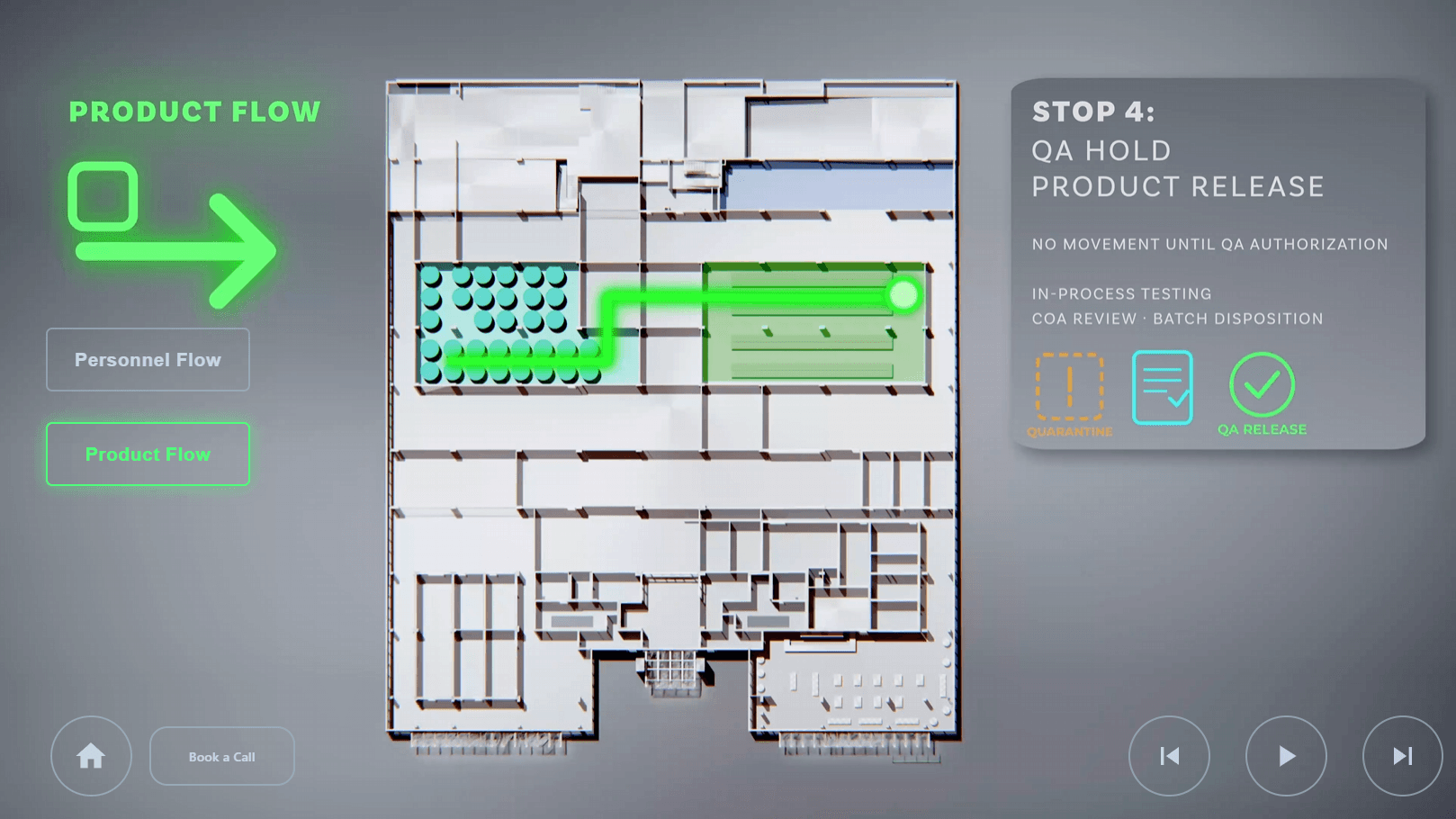
Product The path finished or in-process product travels through the facility. Product flow moves in one direction - from manufacturing toward packaging and dispatch. It never reverses back toward raw material areas.
Raw Materials Incoming materials enter the facility through a dedicated receiving area - typically a Material Airlock, or MAL. They are staged, inspected, and transferred into the manufacturing area without crossing the personnel or product paths.
Waste Waste exits the facility on its own route - separate from every other path. Pharmaceutical waste, packaging waste, and contaminated materials all leave through designated exits that never intersect with incoming materials or active product flow.
Equipment Large equipment and components move through the facility on their own path as well. Equipment corridors are sized and routed to keep maintenance activity separate from active manufacturing and personnel movement.
What happens when they cross
A flow path violation doesn't always result in a contaminated batch. But it creates the conditions where contamination becomes possible - and in a regulated environment, that possibility alone is enough to trigger a deviation report, an investigation, and potentially a shutdown.
Regulatory reviewers look at flow path logic closely during facility approval. If the paths aren't clearly documented and demonstrably separate, the facility doesn't move forward.
Why animation makes this easier to communicate
Flow paths exist in three dimensions. They move through airlocks, around equipment, across multiple zones. On a flat floor plan they're represented by arrows and color coding - but the sequence, the separation, and the logic can be hard to follow for anyone who hasn't spent years reading facility drawings.
Animation solves that. Each path moves through the facility in sequence. The viewer sees personnel enter, gown, and move through the correct zones. They see product travel downstream. They see waste exit without crossing anything it shouldn't.
The compliance logic becomes visible. Not just to the engineer who designed it - but to the architect presenting it, the executive approving it, and the capital partner funding it.